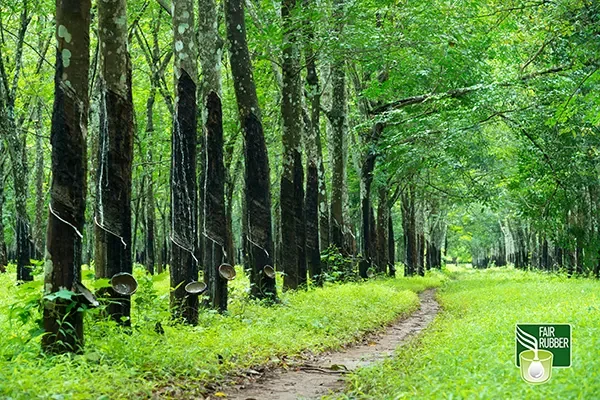
Natural rubber and the current challenges
Fair Rubber improves the working and living conditions of producers and the sustainable cultivation of natural rubber. Members of Fair Rubber e.V. pay a fair trade premium to producers per kilogram of rubber. In this way, the Fair Rubber seal ensures fair trade and environmentally friendly rubber production.
„The Fair Rubber logo is the most widely used seal in rubber production. Over 30 companies from the FMCG (fast-moving consumer goods), construction, medical and textile industries are members of Fair Rubber and support fair trade and environmentally friendly rubber production with their shoes, household goods, bicycle accessories and other consumer goods," says Stefan Hörmann, Managing Director of Fair Rubber e.V.
Despite the positive developments within the Fair Rubber cosmos, there are still real challenges in sustainable rubber supply chains, such as climate change, price pressure, geopolitics and compliance requirements.
Climate change
There is a high degree of dependence on stable climatic conditions, such as yield risks.
Natural rubber comes mainly from Southeast Asia. Extreme weather events such as floods, droughts or changing rainfall cycles affect yields and quality.
Climatic changes favour fungal infestation (e.g. leaf fall disease), which causes crop failures and longer regeneration times for plantations.
Pricing pressure
Structural undervaluation meets volatile markets. Natural rubber is in direct competition with synthetic rubber (petroleum-based), whose price is heavily dependent on the oil market.
Smallholder structures (around 85–90% of production) bear the greatest risk, but often receive prices close to or below production costs.
More sustainable, traceable or certified qualities are more expensive – so far, the market has only rewarded this to a limited extent.
Geopolitics
Global dependencies and new power axes are emerging.
The strong focus on a few countries of origin makes supply chains vulnerable to political instability, export restrictions or infrastructure problems.
China is one of the largest consumers of natural rubber. As a result, changes in trade policy, storage strategies or economic conditions have a direct impact on world market prices.
Geopolitical tensions, sanctions, rising transport costs and disrupted sea routes affect delivery times and costs.
Compliance & Regulation
Requirements are growing, but transparency remains limited. Take the EU Deforestation Regulation (EUDR), for example, which is a very welcome directive. In connection with deforestation-free production, companies must prove that natural rubber is not associated with deforestation or illegal land use.
Traceability remains particularly difficult in complex, fragmented supply chains with many intermediaries.
Social standards such as labour rights, fair pay, land rights and child labour are becoming a greater focus of audits and reporting. This increases the documentation effort, as high administrative requirements are imposed on producers who often have few resources for formal compliance.
The consequences of all the above points are rising costs and the possible exclusion of suppliers.
The solution: active partnership models
Resilient partnerships and long-term relationships are more important today than ever before. This is also the proposed solution that emerges from a recent study by the Global Nature Funds
At CHARLE, we have been working from the outset to build long-term, stable relationships with our suppliers, make conscious material choices and take a clear stance on quality, durability and responsibility. Since 2011, we have been sourcing our natural rubber from the same supplier. A supplier who has since spoken out explicitly against child labour, delivers consistent quality, now manages FSC-certified plantations and is fundamentally interested in environmentally and socially responsible development.
With the support of Fair Rubber e.V., we want to actively improve the conditions for small farmers and plantation owners. This requires a lot of time, patience and persuasion, but it will pay off in the long term.
What is also needed are strong customers, companies and global players who consciously follow our path and remain at our side in the long term. After all, appreciation for our responsible approach loses its impact if decisions are ultimately made in favour of cheaper, less committed providers.