
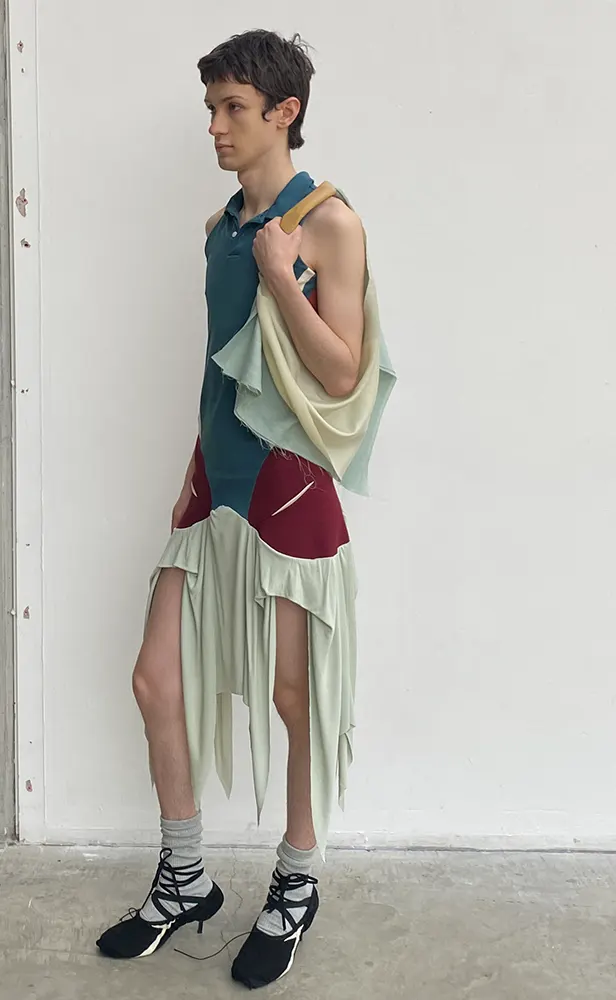
The collection asks: How can we look queer in everyday life—beyond the night, beyond parties and performances? Each piece creates a dialogue between body, space, and identity, between tension and relaxation, openness and protection.
Only biodegradable fabrics were used, including wool, deadstock silk, bamboo jersey, and natural rubber elastic bands, the latter from CHARLE.
We asked Jacek a few questions.
About Jacek

1. You were born in Barcelona in 1999—how did your background or upbringing shape your view of fashion?
I find Barcelona very inspiring! It has an incredible energy: light, approachable, cultural and a bit mischievous… I hope all of this can be perceived in my work too! People dress really well there, with a Mediterranean sensibility that is smart but also joyful.
2. When did you realize you wanted to study fashion—and why did you choose Central Saint Martins in London?
I knew I wanted to do fashion since I was a child, but when the time to pick my studies came around, I was afraid and went into advertising. I very quickly realised that it was not what I wanted to do and, while I was studying, I started researching and reading a lot about fashion and worked as a stylist. After a couple of years, I thought that I wanted my relationship to fashion to be deeper than just styling other people’s work, I needed to make my own clothes.
hat’s when I decided it was time to study fashion, and I am glad that I didn’t get to it straight after high school, the things I would have made at 18 would have been terrible! I went into it being a bit more mature, which was great. I applied to CSM because by that point I had read so much about it and all the great people that had studied there that it had become a sort of sacred destination, going there was like a creative pilgrimage.
Origin of the idea

3. Were there any formative encounters or experiences during your studies that influenced your work?
Absolutely! CSM is often portrayed as a very competitive environment, but we had a great class. Both in terms of ideas and people. Each of us had very different skills, and we all helped each other with our areas of expertise. My friend Petra is incredibly skilled with her construction and really helped me with deciding how to produce the clothes, and my friend Tuuli is such a great storyteller, so we had a lot of conversations about the narrative of the collection.
4. Do you remember the moment when it became clear that Nijinsky's diary would be the starting point for your master's thesis?
Yes! I was in the library researching historical Polish queer figures (my father is Polish) and found a painting of Nijinsky that I recognised from the cover of a book I had bought for a partner 5 years before, featuring him in his costume for ‘L'après-midi d'un faune’. I looked for more images of the same performance and immediately became obsessed. Later that summer I read his diary, which inspired me to keep my own as well.
5. What touched you most about Nijinsky's combination of dance, emotion, and intimacy?
How honest his work is, and how much I could relate to it as well. In the piece I mentioned, ‘L'après-midi d'un faune’, he portrays a young faun that becomes infatuated with a group of nymphs. He is too shy to properly approach them but ends up dancing with the scarf that one of them leaves behind. The scarf becomes a physical representation of his longing. The contrast between the tightness of his dance costume and the easiness of the scarf is what inspired most of the collection!
Content dimension

6. Your collection combines dance and fashion. What does movement as a means of expression mean to you—personally and artistically?
Movement is so important to me. Gesture is the driving force behind my work. I’d like for the clothes to alter the way the wearer moves; offer a sense of lightness, gracefulness, approachability, flirtatiousness.
7. Your collection questions why queer fashion is often intended for nighttime. How do you envision a “queer look” for everyday life?
Connecting to the previous question, it’s all about movement! It’s about a way of walking, speaking, moving your hands, I hope the clothes become a physical manifestation of this way of moving through the world, and that it can accompany you to work, a museum, the park, a party …
Design & Materiality

8. You play with contrasts such as tightness and looseness, tension and relaxation. How do you implement these contrasts technically?
The idea of tension and release is most developed in the jersey pieces, which combine two kinds of plant-based jersey; a very rigid and thick one that sticks to the body and a very light one that comes out of it and moves around the wearer. The CHARLE elastics were key in creating this contrast, as they kept the tight elements in place!

9. The trench coat with open seams and the shirt made of floating ribbons are powerful images—what thoughts are behind these decisions?
The concept behind those garments was exploring the idea of openness. Keeping seams open, or in the case of the ribbons, separating them with a hand-stitching technique called ‘faggoting’, is all about approachability, it’s about saying ‘I’m open’ - to other people, experiences, the world.
10. You made a conscious decision to use biodegradable fabrics. What role does sustainability play for you—especially in a conceptual, artistic collection?
Natural fibres have an honesty to them; they are not trying to emulate something they are not (as most synthetic fabrics do), which make them ideal for a collection about intimacy. They also have a life of their own, they are used and then can be biodegraded, they are like living beings, they carry a story.

11. Our circular elastics are an integral part of your collection. Can you describe your experience with them?
The first thing that impressed me about the CHARLE elastics was their beautiful off-white cotton colour. Being so used to seeing optic white plastic elastics, these organic cotton ones feel and look much more natural, and they look incredible! Therefore, not only were they very useful for their practicality (keeping elastic garments in place), but also for their aesthetic value. I included them in all shoes for the collection. The kitten-heel ballet shoes use the elastics not only as a way of holding the foot, but also as a visual design feature.
Identity & Physicality
12. For you, “looking queer” also has to do with movement. How does the body influence fashion—and vice versa?
Fashion is always about the body! Through the way we move, and through the way we dress our bodies, we present to the world the person we want to be.
13. You mention affectation and effeminacy as gestural qualities that you wanted to make visible. What does it mean to you to frame these characteristics positively?
I’ve always been fascinated by this kind of gesture. I think I want to challenge the misogynistic idea that a man that embodies qualities usually associated with women (a way of walking, the tone of his voice, etc) is ridiculous, funny, or humiliating. I want to portray these characteristics as elegant, mature, and sophisticated instead.
Outlook & Reflection
14. What did you learn about yourself while working on the collection?
That I really want to do this for the rest of my life, and that through design, I am building a representation of the person I’d like to be.
15. Where do you see yourself after completing your master's degree—in artistic fashion, in dance, or at the intersection of both worlds?
Definitively in fashion, although I’d love to do costume for dance at some point too. I am currently working on a collection I am showing with Fashion East in September during London Fashion Week, and I hope there will be many more to come!
Update: Photos from London Fashion Week ‘Fashion East’